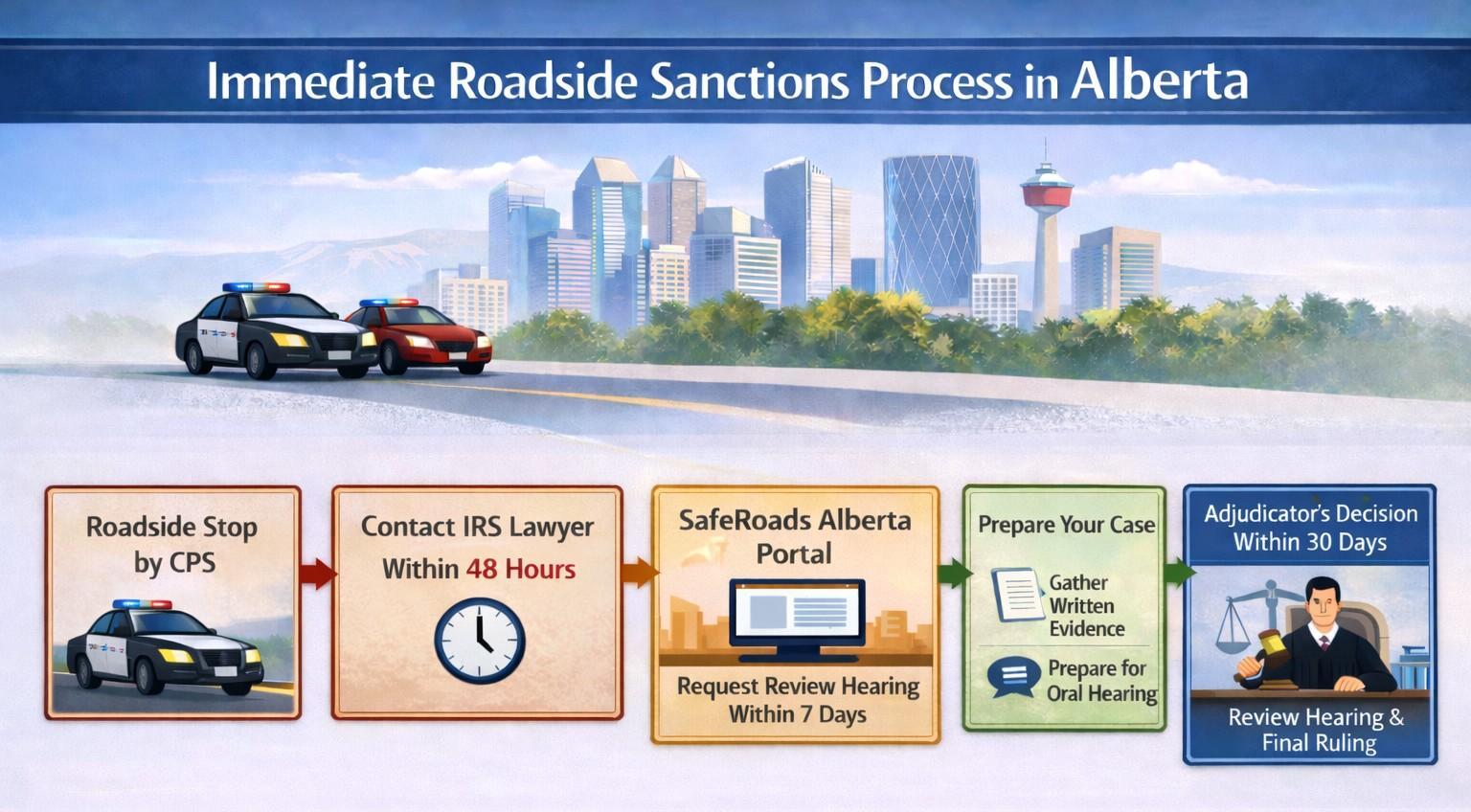
At Strategic Criminal Defence, our IRS lawyers provide the aggressive advocacy needed to challenge these administrative penalties.
With 700+ Google Reviews, a 5-star Google rating, and over 10,000 cases defended across Canada, we provide the strategic edge required to navigate Alberta’s Traffic Safety Act.
Why you must act now: The 7-day appeal window
Unlike criminal charges, an IRS takes effect the moment it is issued.
You have a strict 7-day deadline to apply for a review through SafeRoads Alberta. Failure to act within this window results in a permanent loss of your right to appeal.
As per Alberta’s Traffic Safety Act, the length and type of IRS will depend on the type of licence and the results of the police’s roadside screening.
There are 5 different types of sanctions (explained in more detail below):
- IRS: 24-Hour
- IRS: Novice
- IRS: Commercial
- IRS: Warn
- IRS: Fail
Contact us for a free, no-obligation consultation.
You just received an immediate roadside penalty in Calgary. What next?
- Do Not Pay the Fine: Paying the fine detailed in your Notice of Administrative Penalty is a “deemed admission” of guilt.
- Contact Us Immediately: Contact us the same day to discuss the details of your case with an experienced IRS lawyer.
- Await an Adjudication Date: We’ll request an ‘oral review’ within 7 days of the issue date with SafeRoads Alberta.
- Follow Your Lawyer’s Instructions: We’ll prepare your appeal against the sanctions and present your case to the adjudicator.
“Everything happens very, very quickly from the date that a driver is issued the Notice of Administrative Penalty. You only have seven days to tell SafeRoads Alberta that you want to challenge the suspension. If you misplace the document or don’t realize its significance, it doesn’t matter how good your defence is; the SafeRoads Alberta adjudication department will say, “Sorry, you’re out of time. “
Michael Oykhman, Senior Criminal Defence Lawyer
How IRS replaces criminal charges for impaired driving
Since 2020 in Alberta, IRS administrative penalties have been the default for most first-time impaired offences, under the Provincial Administrative Penalties Act (PAPA). However, the police retain the discretion to lay criminal charges and often do so if aggravating factors are present.
The standard absence of criminal penalties often convinces drivers that they should simply pay the fine and move on. This is generally a mistake.
Although you may not need to set foot in a police station or courtroom, provide a blood sample, or navigate a criminal record, the consequences of an IRS can be highly disruptive and expensive, including:
- Vehicle seizure,
- Immediate loss of licence, and
- A hefty fine.
Under Alberta’s Traffic Safety Act, Calgary police officers can ask you to blow into an approved screening device (usually a hand-held Alco-Sensor FST or Dräger Alcotest 7000) at traffic stops.
If you register ANY positive alcohol reading, the police have the power to issue an on-the-spot impaired driving or over .08 sanction based solely on their observations during the stop.
| IRS TYPE |
ALCOHOL/DRUG CRITERIA |
LICENCE SUSPENSION |
VEHICLE SEIZURE |
BASE FINE |
| IRS: Fail |
BAC of .08 or over (or drug impairment) |
90 days (Immediate) |
30 days |
$1,000 |
| IRS: Warn |
BAC between 0.05 and 0.079 |
3 days (Immediate) |
3 days |
$300 |
| IRS: 24-Hour |
Suspected alcohol or drug impairment |
24 hours (Immediate) |
24 hours |
N/A |
| IRS: Novice |
Any alcohol or drugs (Zero tolerance) |
30 days (Immediate) |
7 days |
$200 |
| IRS: Commercial |
Any alcohol or drugs (Zero tolerance) |
3 days (Immediate) |
N/A |
$300 |
“An immediate roadside sanction is not a criminal charge. It does not go on a criminal record. It does not result in a criminal conviction. It does not lead to deportation. It does not show up on background checks. Yet, considering it’s essentially a glorified traffic ticket, it carries very serious consequences for drivers.”
Michael Oykhman, Strategic Criminal Defence
When might criminal charges accompany the IRS?
You will likely only face separate criminal charges if the police find evidence of the following:
- A very high blood alcohol concentration.
- Damage to another vehicle.
- Injuries to an accident victim.
- Multiple repeat offences.
Regardless of whether the police decide to pursue criminal charges, contacting an IRS lawyer should be your initial priority, due to the rigorous and tight deadlines.
If criminal charges do follow, your Strategic Criminal Defence lawyer can often use the information gathered from the IRS appeal to start building your criminal case defence to prevent additional harsh penalties.
Challenging the IRS reverse onus: Why you carry the burden of proof
Immediate Roadside Sanctions turn one of the main precepts of Canadian criminal law on its head: the presumption of innocence, as guaranteed under the Canadian Charter of Rights and Freedoms to anyone charged with a crime.
The problem is you’re not usually charged with a crime. Under the current law, you have no presumption of innocence with roadside sanctions.
The ‘burden of proof’ also shifts to the driver. Now, you must prove you didn’t do it, rather than the police proving you did.
Challenging the penalties and their severe consequences is complex, but the IRS lawyers at Strategic Criminal Defence have handled over a thousand such cases and are adept at persuading adjudicators to reconsider the administrative decision.
“Unlike criminal cases, where you’re presumed innocent until proven guilty, when you receive a notice of administrative penalty, you’re already deemed guilty. You’ve been issued your penalty, are already serving it: the fine is already imposed and due, the suspension already started, and the vehicle is already towed and in the lot for 30 days. The only way to overcome these penalties is to challenge them through the Administrative Review process.”
Michael Oykhman, Senior Criminal Defence Lawyer
The hidden costs of an immediate roadside sanction
You may escape the burden of a criminal record, but there’s no way to escape the driving suspension, considerable financial implications, and other long-term consequences unless you successfully challenge the sanctions.
An IRS will still show on your driver’s abstract, which can be viewed by insurance companies, and potentially by employers for jobs that involve driving.
The financial consequences extend beyond the immediate fines. Most drivers greatly underestimate the total costs.
Here are your estimated costs for a roadside FAIL sanction:
| CATEGORY |
ITEM |
ESTIMATED COST (CAD) |
NOTES |
| Immediate Penalties |
Government Fine |
$1,200 |
$1,000 base fine + 20% victim fine surcharge. |
|
Vehicle Seizure |
$200-$350 |
Varies by towing company and distance to impound. |
|
Vehicle Storage (30 days) |
$1,050-$1,500 |
Based on $35-$50/day storage fees in Calgary. |
|
Impound Release Fee |
$35 |
Charged by the registry to get the release paperwork. |
| Licence Reinstatement |
'Planning Ahead' Course |
$380-$400 |
Mandatory remedial education course. |
|
Licence Reinstatement Fee |
$209 |
Standard Alberta alcohol-related registry fee. |
| Ignition Interlock Program (IIP) |
IIP Application Fee |
$63 |
Non-refundable application to Alberta Transportation. |
|
Installation Fee |
$150-$250 |
Surcharge applies for push-start or luxury vehicles. |
|
Monthly Rental (12 Months) |
$1,200-$1,400 |
Approx. $100-$115/month for the device lease. |
|
Removal Fee |
$50-$100 |
Charged at the end of the 12-month term. |
| Insurance Impact (3-Year Period) |
Premium Increase Including High-Risk Surcharge |
$3,000-$5,000 |
Per year for three years. Many drivers see rates triple (300% increase). |
| SafeRoads Alberta Appeal |
|
$150 |
Non-refundable government fee to request a review. |
|
TOTAL |
$6,500-$25,000+ over three years! |
|
These estimated fees alone are reason enough to fight the sanctions.
For repeat offenders, the penalties are more severe than the first-time offence penalties outlined.
“Even though it’s not a criminal DUI, insurance companies treat it as the equivalent. The financial penalties can be very significant, even for a first-time offence.”
Michael Oykhman, Senior Criminal Defence Lawyer
How do we fight immediate roadside sanctions in Calgary?
We will manage the appeal process for you from start to finish:
- We contact SafeRoads Alberta through their portal within 7 calendar days (not business days!) of you receiving the Notice of Administrative Penalty (NAP).
- We request an administrative review so that we can argue the case in front of an adjudicator on your behalf.
- We will select an oral review, as this allows our lawyers to use both written and oral evidence when supporting your case.
- We will conduct your defence virtually from our centralized offices in Calgary or Edmonton (you do not need a lawyer in your specific jurisdiction).
Our lawyers almost always choose oral reviews, as oral arguments build on the written materials and provide an opportunity to contextualize, clarify details, and answer adjudicator questions.
We often need to outline in writing where the police failed to comply with the procedural protections that our clients are entitled to. However, some adjudicators are new and unfamiliar with the complexities of the arguments we make. Oral reviews allow a more comprehensive approach.
“In these cases, unlike criminal cases or even traffic tickets, there’s no ‘wiggle room’ for negotiation. There are no prosecutors or officers to talk to and no one to negotiate or plea bargain with. The only options you have are to either fight it or not fight it, and if you do fight it, the adjudicators have only two options available: cancel everything or uphold everything.”
Michael Oykhman, Senior Criminal Defence Lawyer
Testimonials
“I have to say, I’m lucky because I met Metaya Selders in this law company. For some unbelievable reasons, I got into a defensive trouble, she’s so patient and friendly; finally, she helped me resolve this problem for me. She’s professional lawyer!!!! Every one can trust her!!”!
“Shervin went far and beyond to help me, he was very professional and was able to help me understand everything I needed to know about my case.”
“We cannot express enough gratitude to Michael Oykhman and Mateya for their incredible assistance in resolving an IRS penalty case. After thoroughly researching attorneys in Calgary, we felt the most confident proceeding with them, and all our expectations were exceeded. From the very first consultation to the resolution of our case, they demonstrated professionalism, compassion, and an incredible attention to detail. Their communication with us was outstanding—they kept us informed every step of the way and ensured we fully understood the process, which gave us so much peace of mind during a very stressful time.
Thanks to their expertise, dedication, and tireless efforts, the IRS case was completely dismissed—a result we didn’t dare dream could happen but are so thankful to have achieved!
We are beyond thankful for their hard work and commitment. If you are in a similar predicament, please reach out to Michael and Mateya. We cannot recommend them enough!”
Typical defences in IRS cases
After an initial consultation to understand the details of your case, a Strategic Criminal Defence IRS lawyer will begin working on your defence for the administrative review process.
The most common IRS defences include:
| DEFENCE CATEGORY |
LEGAL/TECHNICAL BASIS |
EXAMPLES/KEY DETAILS |
| Improper testing procedure |
Technical invalidity |
Failure by the police officer to observe the 15–20 minute "deprivation period" (ensuring no burping, eating, or smoking) before the breath test. |
| Medical conditions |
Inaccurate readings |
Diabetes/Ketoacidosis: Can produce acetone, mimicking alcohol. GERD/Acid Reflux: Can bring stomach vapors into the mouth. |
| Physical inability |
Misinterpreted 'refusal' |
Respiratory issues (Asthma, COPD) may prevent a 'proper sample', which officers sometimes wrongly label as a criminal refusal. |
| No 'care or control' |
Factual defence |
Proving you had no intent to drive (e.g., sleeping in the car to stay safe or running the engine solely for heat while parked). |
| Charter rights violations |
Constitutional defence |
Violations of your right to be informed of the reason for detention or your right to speak with a lawyer (Right to Counsel). |
“The conduct of the police and whether your rights were violated is often the first place we look. Did the police implement the roadside appeal process correctly? Did they comply with the procedural protections afforded to every driver? Many defences have nothing to do with whether you’d consumed alcohol. We’re often surprised how commonly the police fail to provide a sufficient record of what happened during the investigation.”
Michael Oykhman, Senior Criminal Defence Lawyer
How we use the new IRS regulations to bolster your defence
Recent updates to the Immediate Roadside Sanctions program may help us mount a stronger defence to your administrative penalties.
Body-worn cameras may help your defence
For Calgary Police Service IRS filings, law enforcement officers in the city must wear digitized body-worn camera (BWC) evidence integration. BWCs must be fully operational during every traffic stop.
We can request access to the footage on your behalf. If it doesn’t match the officer’s written report, it may provide evidence to challenge the ‘reasonable grounds’ of the officer’s initial assessment.
For instance, if you were accused of ‘slurred speech’ or ‘unsteady feet,’ but the video doesn’t back this up, the entire sanction can be invalidated.
Breathalyzer calibration may be the key to your case
New, stricter standards for Approved Screening Device (ASD) maintenance logs in the Calgary region in can also generate more evidence to build your defence:
If the Alco-Sensor FST or Dräger Alcotest 7000 used in your case failed to comply with mandatory calibration cycles or expired dry gas standard certificates, the result may be legally inadmissible.
Seek legal help within the first 48 hours
Although the appeal window is seven days, it’s best to seek legal intervention within the first 48 hours. This allows your lawyer to file an Application for Review before the police disclosure is finalized, preventing ‘clerical fixes’ by the Crown or CPS.
Police filing deadlines have become tighter:
- The NAP must be uploaded by the officer to the SafeRoads portal promptly (usually within a 24-hour window of the roadside event).
- Delays may result in a ‘jurisdictional error,’ potentially allowing for a cancellation of your suspension if the delay prevents you from exercising your right to appeal.
What are your chances of overturning an IRS?
If you don’t appeal your sanctions, you’ve already ‘lost’. Your only chance of reversing the penalties is by presenting a strong defence, forcing SafeRoads Alberta to withdraw them.
It is surprisingly common for trained police officers to make basic procedural mistakes. This is why you should never pay the fine and simply admit guilt in IRS cases. Appealing is almost always the best course.
“Everybody asks us, ‘What are the chances of winning?’ We don’t win every case, but our team has successfully defended hundreds of these cases (maybe even thousands, we’ve lost count!). The only guarantee we give is this, though: If you don’t file a review within seven days and have your case heard in front of an adjudicator, you’re 100% guaranteed to face all the consequences listed.”
Michael Oykhman, Senior Criminal Defence Lawyer
Our recent successful cases
For additional details on how we have successfully challenged IRS cases, visit our IRS Successful Cases page.
Case Number: 55342520
Our client faced an Immediate Roadside Sanction (IRS: Fail) for allegedly operating a motor vehicle with a blood alcohol concentration (BAC) exceeding 80 milligrams per 100 milliliters of blood and impaired operation of a vehicle. The allegations arose after the client’s vehicle was found in a ditch near Banff National Park. Despite two separate breath tests indicating “Fail,” we identified critical deficiencies in the records provided, specifically related to the calibration of the devices used.
The investigation revealed that the approved screening devices (ASDs) used for both the initial test and the voluntary roadside appeal showed calibration dates listing a date nearly one year into the future. This glaring inconsistency raised doubts about the reliability of the devices. Although the issuing officer claimed this was a typographical error and the devices were calibrated in 2024, there was no corroborating evidence from the calibrator or records verifying the actual date. This oversight undermined the reliability of the results and the fairness of the administrative sanction.
At the review hearing, Michael Oykhman (Counsel) and M. Selders (Co-Counsel) argued that the absence of accurate calibration records violated procedural requirements under Section 2 of the SafeRoads Alberta Regulation and Section 12 of the Provincial Administrative Penalties Act. The adjudicator agreed, finding that the lack of reliable calibration information rendered the NAP invalid. The adjudicator determined that the client had established sufficient grounds to cancel the sanctions.
Successful Result: IRS Fail Cancelled, No Suspension.
Case Number: 9245473
Our client faced an Immediate Roadside Sanction (IRS: Fail) for allegedly operating a motor vehicle while impaired by cannabis. The sanction was issued following a traffic stop on Highway 1A near Cochrane, Alberta, during which the officer claimed the client displayed signs of impairment and admitted to recent cannabis consumption. Despite these allegations, we identified key flaws in the investigation and the evidence used to support the sanction.
During the stop, the officer noted the smell of burnt cannabis, observed red and bloodshot eyes, and cited the client’s admission of recent consumption. However, the client provided a breath sample on an approved screening device (ASD) that showed a blood alcohol concentration (BAC) of “0.” Despite the officer identifying himself as a “senior drug recognition expert” (DRE), no further testing, such as a DRE evaluation or a standard field sobriety test (SFST), was conducted to substantiate the officer’s claims of impairment by drugs.
At the review hearing, Ian Savage (Counsel) effectively demonstrated that the officer’s observations were insufficient to establish impairment under Section 4(e)(iv) of the SafeRoads Alberta Regulation. The officer’s reliance on subjective observations, without corroborating evidence from approved drug screening or further testing, failed to meet the required standard to uphold the sanction. Additionally, the client provided a credible and detailed explanation of her cannabis use and driving behaviour, which further undermined the officer’s claims.
The adjudicator concluded that the evidence did not establish impairment at the time of operation on a balance of probabilities. The Notice of Administrative Penalty (NAP) was therefore cancelled.
Successful Result: IRS Fail Cancelled, No Suspension.
Case Number: 9255461
Our client faced an Immediate Roadside Sanction (IRS: Fail) for allegedly operating a motor vehicle while impaired by alcohol or drugs. The sanction was issued following a complaint about the client being found unconscious in a vehicle that had backed into another car. Despite allegations of impairment and a subsequent drug recognition evaluation (DRE), we successfully demonstrated that critical procedural errors invalidated the sanction.
The investigation began with the client being arrested for impaired driving and hit-and-run. While the officer conducted various assessments, including an ASD test that returned a reading of “0” for alcohol and a DRE evaluation, the client was not provided a Notice of Administrative Penalty (NAP) or any written advice about their right to a voluntary roadside appeal until after the tests were completed. This failure to issue the NAP at the appropriate time directly violated the procedural requirements outlined in the Traffic Safety Act and relevant case law, including Lausen v. Alberta (Director of SafeRoads) and Lawrence v. Alberta (Director of SafeRoads).
At the review hearing, Laura Bobyn (Counsel) effectively argued that the officer’s failure to issue the NAP prior to the roadside appeal deprived the client of the opportunity to make an informed decision about the voluntary appeal. The adjudicator agreed, noting that the timing and delivery of the NAP were inconsistent with legal requirements. This procedural deficiency undermined the fairness of the process, leading to the cancellation of the sanction.
Successful Result: IRS Fail Cancelled, No Suspension.
Case Number: 55542511
Our client faced an Immediate Roadside Sanction (IRS: Fail) for allegedly operating a motor vehicle while impaired by alcohol following a traffic collision. The peace officer issued a Notice of Administrative Penalty (NAP) and presented the client with a verbal explanation of a roadside appeal. However, no written advice about the voluntary nature of the appeal or its implications was provided before the appeal was declined.
The incident began when law enforcement stopped the client after observing them leaving the scene of a collision. The client was arrested, handcuffed, and placed in the back of a police vehicle. Despite the officer mentioning the appeal, the absence of written documentation and clear communication led the client to mistakenly believe that declining the appeal would result in worse consequences, such as criminal charges.
At the review hearing, we highlighted procedural deficiencies in the officer’s conduct. We argued that the failure to provide written advice regarding the voluntary nature of the appeal violated procedural safeguards under Section 88.11 of the Traffic Safety Act. Drawing on key precedents, including Lausen v. Alberta (Director of SafeRoads) and Lawrence v. Alberta (Director of SafeRoads), we demonstrated that these deficiencies deprived the client of their right to meaningful access to a roadside appeal.
The adjudicator agreed that the officer’s omissions rendered the process unfair. The NAP was canceled, and no suspension or further penalties were imposed.
Successful Result: IRS Fail Cancelled, No Suspension.
Case Number: 55342516
Our client faced an Immediate Roadside Sanction (IRS: Fail) for allegedly operating a motor vehicle with a blood alcohol concentration (BAC) exceeding 80 milligrams per 100 millilitres of blood, following a traffic stop in Calgary, Alberta. This was a second occurrence, significantly raising the potential penalties and risks involved. Despite the breathalyzer results indicating a “Fail” after two separate tests, critical procedural deficiencies were identified in the investigation and explanation of the client’s rights.
The traffic stop arose from a complaint of impaired driving. After the initial “Fail” reading on the approved screening device (ASD), the peace officer arrested the client and referenced prior sanctions. The officer informed the client of the option for a roadside appeal but failed to provide timely written advice or documentation about its voluntary nature and purpose. The appeal form was presented in a rushed and unclear manner, leaving the client unaware of their rights or the distinction between criminal and administrative consequences.
During the review hearing, we emphasized the officer’s failure to meet procedural requirements under Section 88.11 of the Traffic Safety Act, particularly the lack of timely and adequate written advice about the roadside appeal. We argued that this oversight, combined with the client’s prior experience and heightened anxiety, resulted in significant unfairness. Relying on legal precedents such as Lausen v. Alberta (Director of SafeRoads) and Lawrence v. Alberta (Director of SafeRoads), we demonstrated that these procedural flaws denied the client meaningful access to safeguards against administrative sanctions.
The adjudicator agreed and canceled the NAP.
Successful Result: IRS Fail Cancelled, No Suspension.
Case Number:
Our client faced an Immediate Roadside Sanction (IRS: Fail) for allegedly operating a motor vehicle while impaired by alcohol. The incident occurred after police responded to a complaint about a driver found unconscious behind the wheel of a parked vehicle. Despite allegations of impairment, we identified procedural deficiencies in how the investigation and sanctions were conducted.
Law enforcement claimed that our client exhibited classic signs of impairment, including the smell of alcohol, slurred speech, and unsteady movement. The client was arrested, read their Charter rights, and placed in the back of a police vehicle. However, the investigating officer failed to provide written documentation or a clear explanation of the client’s rights to a voluntary roadside appeal. The roadside appeal was allegedly offered verbally, but no detailed information was provided about its purpose, voluntary nature, or potential impact. Instead, the client was handed documentation only after being transported home, long after the opportunity to elect a roadside appeal had passed.
At the review hearing, Michael Oykhman (Counsel) and M. Gill (Co-Counsel) demonstrated that the investigating officer’s actions violated procedural safeguards outlined in Section 88.11 of the Traffic Safety Act. Drawing on precedents such as Lausen v. Alberta (Director of SafeRoads) and Lawrence v. Alberta (Director of SafeRoads), they argued that the officer’s failure to provide timely written advice undermined our client’s ability to make an informed decision. The adjudicator agreed, finding that the lack of proper communication and documentation rendered the process unfair and procedurally flawed.
Successful Result: IRS Fail Cancelled, No Suspension.
What can you expect after you win or lose your IRS appeal?
Whether you were successful or failed in your appeal, the decision is generally announced within 30 days.
By acting early and locking in an early hearing date, you can reduce waiting times and, if successful, reduce your licence suspension.
When the arguments are particularly clear and convincing, we have even informally received notice of an adjudicator’s decision on the hearing day itself.
This explains the basic timelines associated with IRS penalties in Alberta:
“It’s rare, but we’ve been able to, in some cases, cut the time from driving to adjudicator decision from 30 days to as little as two weeks. Our lawyers can accomplish those types of results.”
Michael Oykhman, Senior Criminal Defence Lawyer
Winning your appeal and having the sanctions reversed
If your appeal is successful, the sanctions you received will be dropped, and any money you paid in fines will be returned.
However, there is a chance you will still face criminal charges. Those charges remain even if you win the IRS appeal. We will defend those charges bolstered by a positive decision in your administrative cases, even though the two processes operate completely independently of each other.
Lost your review? What next?
If you have already lost your review with SafeRoads Alberta, there is one last hope: Filing for a judicial review at the Court of King’s Bench.
This review requests that a judge overturn the SafeRoads Adjudicator’s decision because of a legal or procedural error. To do so, we will:
- File Form 7 within 30 days of receiving your written decision from SafeRoads.
- File the form alongside Form 8 (Notice to Obtain Record of Proceedings), which forces SafeRoads to turn over the “record” (the evidence and the audio of your hearing) to the Court.
Strategic Criminal Defence awards
- Consumer Choice Award Winner: 2025, 2026.
- Three Best Rated® Winner for 8 consecutive years.
- BBB A+ Rated.
Dedicated IRS lawyers at Strategic Criminal Defence
The team of lawyers at Strategic Criminal Defence in Calgary all provide immediate roadside sanctions defence services. View our dedicated lawyer page to learn more about our lawyers and their focus areas.
FAQs
There is a process to file for a late review, but it is an uphill battle that is generally unsuccessful, despite a significant investment of time, energy, and resources. The best way to avoid this issue is to decide to review in the first seven days and lock in the appeal date.
The most critical documents are anything you received from the police outlining the case against you, and specifically the Notice of Administrative Penalty (NAP). You should also prepare any supporting documents that can help explain, clarify, or contextualize what happened, such as text messages, phone call logs, and details of witnesses who can provide additional information. This will be explained in full after an initial consultation.
No, generally not. We rarely have our clients testify in person in front of an adjudicator, as they may say something detrimental to their case due to nerves. Instead, we generally forward to the adjudicator a recording of an in-depth consultation with our client. We also use the recording to compile a comprehensive written statement on their behalf. This allows us to be detailed but also to ‘control the narrative’ with adjudicators.
Yes, but what constitutes a reasonable excuse is very fact-specific. We will explore every aspect of the fact pattern involved in the case to ensure that if you have a reasonable explanation for not providing a breath sample or complying with the demand, we can articulate it properly when making our submissions to an adjudicator.
We have successfully defended cases where factually innocent drivers are issued an IRS for failing or refusing to comply with the demand, even if they hadn’t had a sip of alcohol. If this happens to you, immediately go to the nearest hospital or medical center and ask for a sample of your blood to prove that you had no alcohol in your system. We will use this evidence in your administrative review.
Generally, no, you can’t drive because you lose your driver’s licence right away with an Immediate Roadside Sanction. For an IRS: FAIL (over .08 blood alcohol), your licence will be suspended for 90 days. For a first IRS: WARN (0.05–0.079), it’s three days before you can drive again. Driving while your licence is suspended is a separate, serious crime that can lead to your car being impounded, more fines, and longer suspensions.
You have nothing to lose by appealing roadside sanctions
There is no downside to fighting administrative penalties. The situation cannot get worse for you if you lose the appeal.
Decision-making from SafeRoads adjudicators is binary. They will either:
- Uphold the ruling, or
- Cancel the penalty completely, removing all aspects of the sanctions.
“Adjudicators cannot make it any worse than it already is, but the outcome could get significantly better. The worst thing an adjudicator can do if you fight your sanctions is say, ‘Nice try! But please continue serving the sentence that you’re already well on your way to completing.’”
Michael Oykhman, Senior Criminal Defence Lawyer
Our immediate roadside sanction lawyers will:
- File the necessary paperwork to request a review within the first 7 days of receipt of the NAP.
- Review your case to find the strongest relevant arguments to challenge your roadside suspension.
- Gather key evidence, such as police reports, breathalyzer maintenance records, and video footage, to highlight procedural errors, Charter rights violations, etc.
- Guide you through the process, explaining what’s happening and what to expect at each stage.
Contact us for a free, no-obligation consultation.
Verified By: Michael Oykhman, Senior Criminal Defence Lawyer
Last Modified: May 4, 2026
Michael Oykhman is a senior criminal defence lawyer and the founder of Strategic Criminal Defence, a leading firm with offices across Western Canada and Ontario. With nearly 20 years of legal experience, he has appeared at all levels of court in Alberta, including the Supreme Court of Canada, and has successfully defended thousands of clients.
Experience
- Proven Results: Successfully managed over 10,000 criminal cases, experience in complex matters such as impaired driving, domestic violence, and sexual assault.
- Strategic Problem Solver: Trained as a trial lawyer but recognized for his experience in alternative resolution strategies, often securing the best outcomes for clients without a case ever going to trial.
- Multi-Jurisdictional Authority: Licensed to practice law in Alberta, British Columbia, and Saskatchewan.
Education & Academic Leadership
- Education: Holds a Bachelor of Laws (LL.B.) and a B.A. in Psychology from the University of Calgary.
- Academic Distinctions: Recipient of the Crown Association Prize (top grade in criminal law) and was the first-ever finalist for the University of Calgary at the Gale Cup Moot.
- Teaching & Mentorship: Currently serves as the Advising Lawyer for Student Legal Assistance and is a sessional instructor at the University of Calgary Faculty of Law, teaching Advanced Criminal/Constitutional Appellate Advocacy.
Credentials & Recognition
- Top-Rated Advocacy: An 8-time recipient of the Three Best Rated® Top Criminal Defence Lawyer of the Year award in Calgary.
- Professional Memberships: Active member of the Criminal Trial Lawyers Association (CTLA) and the Criminal Defence Lawyers Association (CDLA) of Calgary.
- Connect with Michael: Bio | LinkedIn | Firm Office: (403) 719-6410