





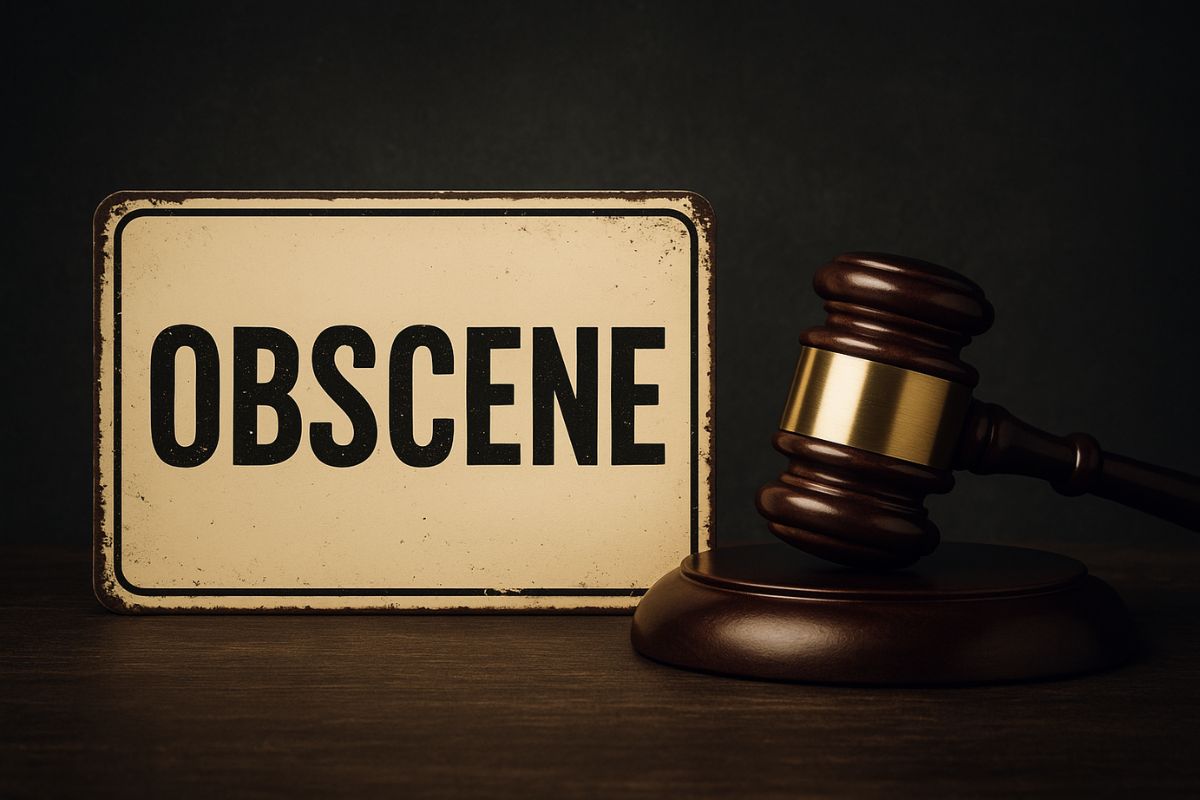






What is an obscenity charge?
The offence of obscenity is covered under Part V of the Criminal Code, which includes “Sexual Offences, Public Morals and Disorderly Conduct.” Obscenity includes the distribution, possession for the purpose of distribution, creation, or production of explicit and sexually explicit material that is considered obscene.
Under Canadian law, any publication whose dominant characteristic is the undue exploitation of sex, or of sex combined with crime, horror, cruelty or violence, is classified as obscene.
To further elaborate, obscenity entails the unjust exploitation of sexual content that surpasses the prevailing benchmarks of tolerance within the Canadian community. Explicit sexual depictions coupled with instances of violence almost invariably fall under the purview of undue sexual exploitation. Should explicit sexual content be both degrading and dehumanizing, it could be deemed undue if it carries a significant risk of harm. However, explicit sexual representations that lack violence, degradation, or dehumanization generally do not qualify as undue sexual exploitation unless they involve minors in their production.
It’s worth noting that material not meeting the criteria for obscenity under this framework cannot be classified as such based on the recipient or the context in which it is displayed. The determination of obscenity does not hinge on the limited audience or market to which it is confined. Notably, mere nudity itself does not constitute explicit sexual content.
Obscenity cases involving children in Alberta
Material involving children is not dealt with as obscenity. Possessing, making or distributing child pornography (child sexual abuse and exploitation material) is a separate and more serious offence addressed under section 163.1 of the Criminal Code. Other related offences like child luring may also be engaged.
Where are obscenity cases heard in Alberta?
An obscenity charge is a hybrid offence with a Crown election. This means that the Crown can elect to proceed either by indictment or summarily. If prosecuted by indictment, there is a defence election of court under s. 536(2) of the Criminal Code. In Alberta, this means you can usually choose a trial in the Alberta Court of Justice or in the Court of King’s Bench of Alberta, with or without a jury.
Examples of obscenity charges
Some examples of activities that could lead to obscenity charges include the following:
- Distributing sexually explicit magazines or videos that are considered obscene.
- Producing and creating explicit content that emphasizes sexual content in a degrading or dehumanizing manner.
- Creating or sharing graphic depictions of violence and sex.
Overview of the offence
According to s.163 of the Criminal Code:
Obscene materials
163(1) Every person commits an offence who makes, prints, publishes, distributes, circulates or has in their possession for the purpose of publication, distribution or circulation any obscene written matter, picture, model, phonograph record or any other obscene thing.
Idem
(2) Every person commits an offence who knowingly, without lawful justification or excuse,
(a) sells, exposes to public view or has in their possession for that purpose any obscene written matter, picture, model, phonograph record or any other obscene thing; or
(b) publicly exhibits a disgusting object or an indecent show.
Defence of public good
(3) No person shall be convicted of an offence under this section if the public good was served by the acts that are alleged to constitute the offence and if the acts alleged did not extend beyond what served the public good.
Question of law and question of fact
(4) For the purposes of this section, it is a question of law whether an act served the public good and whether there is evidence that the act alleged went beyond what served the public good, but it is a question of fact whether the acts did or did not extend beyond what served the public good.
Motives irrelevant
(5) For the purposes of this section, the motives of an accused are irrelevant.
(6) [Repealed, 1993, c. 46, s. 1]
(7) [Repealed, 2018, c. 29, s. 11]
Obscene publication
(8) For the purposes of this Act, any publication a dominant characteristic of which is the undue exploitation of sex, or of sex and any one or more of the following subjects, namely, crime, horror, cruelty and violence, shall be deemed to be obscene.
Punishment
169 Every one who commits an offence under section 163 [obscenity], 165 [tied sale], 167 [immoral thetrical performance] or 168 [mailing obscene matters] is guilty of
(a) an indictable offence and is liable to imprisonment for a term not exceeding two years; or
(b) an offence punishable on summary conviction.
The guilty act (actus reus)
The actus reus for an obscenity charge is established by proof beyond a reasonable doubt of the following:
- The accused at a specified date and time, in the correct jurisdiction, created or distributed sexually explicit material to the public, or possessed sexually explicit material to be distributed; and
- The sexually explicit material is obscene.
The case of R. v. Butler held that material that is not obscene under this framework does not become so by reason of the person to whom it is shown, or the place or manner in which it is shown.
The guilty mind (mens rea)
The mens rea for an obscenity charge includes proving beyond a reasonable doubt that:
- The accused knowingly distributed, created, or possessed for distribution, obscene sexually explicit material; or
- The accused willfully created, printed, published, distributed, or offered for sale, obscene materials.
Section 163 contains two groups of offences, and each has a different mental element.
Making or distributing obscene material (section 163(1))
This covers making, printing, publishing, distributing or circulating obscene material, or having it in order to do any of these things. The section does not use a word such as “knowingly,” but the Crown must still prove that you intended to do the prohibited act.
Selling or publicly displaying obscene material (section 163(2))
This covers selling obscene material, displaying it to the public, having it in order to sell or display it, or putting on an indecent show in public. The law says these acts must be done “knowingly.” This means the Crown must prove that you knew what the material contained, including the specific content that makes it obscene (R. v. Jorgensen, [1995] 4 SCR 55). This can be hard to prove, especially against store owners who sell material they may not have watched or read.
To establish this mental state, the Crown must demonstrate that the accused possessed awareness that the material in question predominantly focused on the exploitation of sex. Furthermore, it must be proven that the accused was cognizant of the specific content that rendered the material legally obscene. In cases where an entire film is alleged to be obscene in its entirety, rather than specific scenes, it is necessary to establish that the seller or retailer had awareness of the overall obscene nature of the film.
‘Wilful blindness’
An instance of ‘wilful blindness’ can serve as evidence of knowledge. Deliberately opting not to acquire knowledge when circumstances warrant further investigation may establish the requisite mental element. In Alberta, the fact that a film has been rated by the Alberta Film Classification Office could also be relevant in deciding whether the accused was wilfully blind.
How to Beat an Obscenity Charge
Every case is different. The strength of any available defence rests on the evidence against you and the precise details of the allegations. However, below are some common defences that may be used when fighting an obscenity charge.
Factual innocence
The Crown must prove that you created, distributed, or possessed for distribution material that is legally obscene. If the evidence does not prove this beyond a reasonable doubt, you may have a defence. For instance, the material may not meet the legal test for obscenity.
Public good
The public good defence applies if what you did was necessary or helpful for religion or morality, the administration of justice, science, literature, art, or other matters of general interest, and did not go beyond what served that purpose. For example, a rating from the Alberta Film Classification Office does not automatically provide a legal excuse for a film’s content, but it may be relevant to what the community will tolerate.
Mistaken belief
If you are charged under section 163(1), you may have a defence if you made an honest mistake about the facts. However, believing that material does not go beyond community standards is not a mistake of fact, so it is not a defence.
Mistake in identity
You may be able to raise an identity defence if the Crown cannot prove, beyond a reasonable doubt, that you were the person who created, distributed, or possessed for distribution the obscene material.
Any applicable Charter defences
If a court finds that your Charter rights were breached, some or all of the evidence against you may be excluded under section 24(2) of the Charter.
Punishments for an obscenity conviction
The offence of obscenity is a hybrid offence, which entails a maximum punishment as follows:
- Imprisonment for 2 years of the Crown elects to proceed by indictment.
- Imprisonment for 2 years less one day if prosecuted by summary conviction.
The penalties associated with an obscenity charge hinge on the particulars of your case. However, no mandatory minimum penalties are stipulated for this charge.
An obscenity accusation carries substantial ramifications beyond the criminal penalties, including on employment prospects, immigration standing for non-citizens, and more.
Importantly, persons found guilty of obscenity may be eligible for a discharge, suspended sentence, stand-alone fine, or probation. A jail sentence is not mandatory.
A criminal defence lawyer can work to limit the consequences of an obscenity charge. Contact us for a free, no-obligation consultation.